LLM-Inspired Techniques for EEG: Promises and Limits
Large language models (LLMs) offer useful engineering ideas for EEG, but EEG is not language. Text tokens carry relatively stable, socially shared meanings and are available at enormous scale. EEG is a continuous, noisy, device-dependent measurement whose meaning changes with montage, reference, task, physiology, and context. The productive question is therefore not how to make EEG ``speak,'' but which LLM-era techniques can produce more reusable, grounded, and controllable EEG systems.
This section separates techniques that address genuine EEG problems from analogies that can overstate what a neural recording reveals. The focus is on affective EEG, but the principles apply to cognitive monitoring, active BCIs, and clinical settings.
A Grounded EEG-LLM Stack
An LLM should not directly interpret raw EEG as a source of unconstrained claims about thoughts, intentions, or diagnoses. A safer architecture gives the language component bounded, calibrated evidence from a signal model, combines it with explicit context, and requires confirmation before consequential actions.
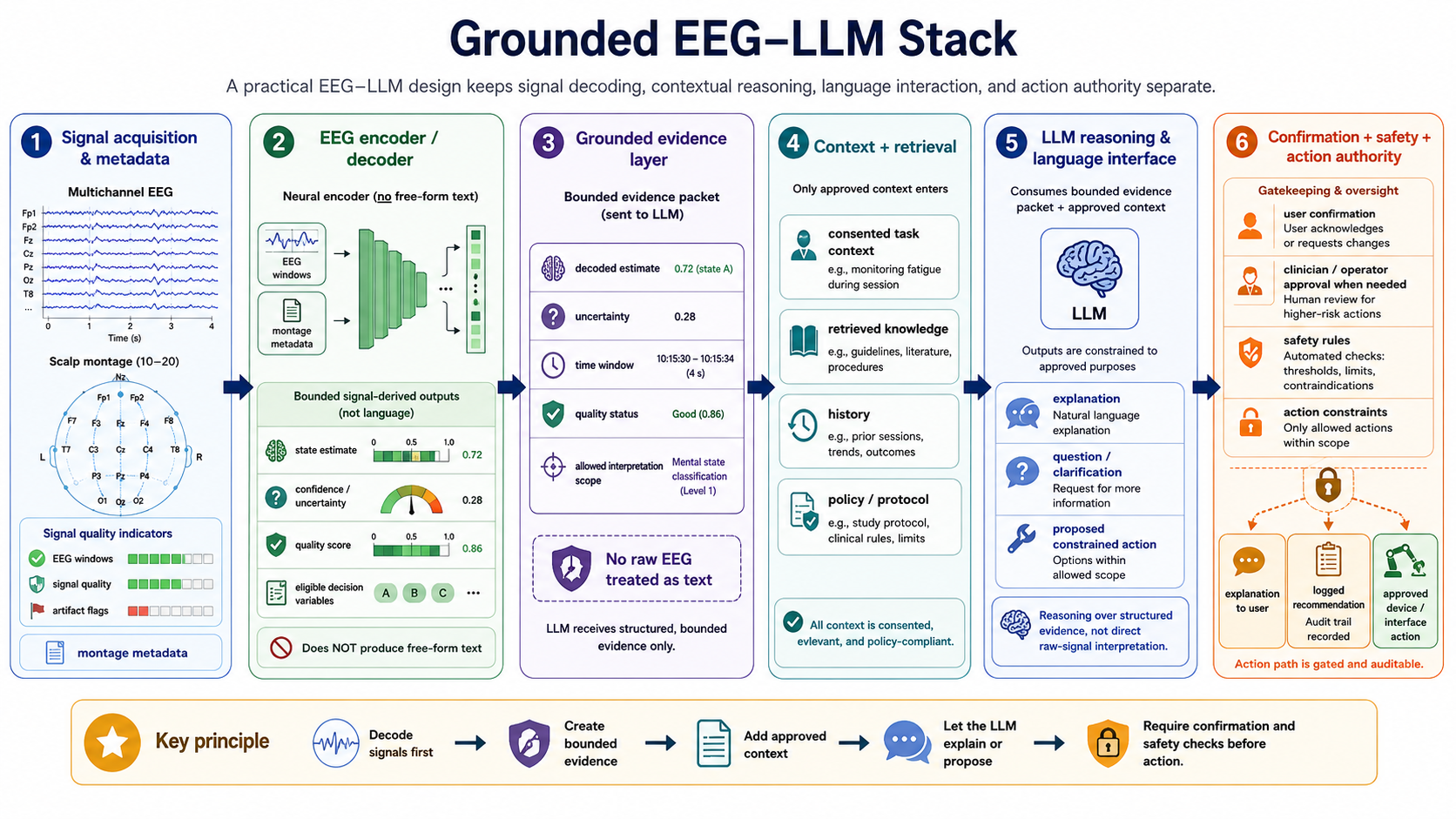
Figure 1. A practical EEG-LLM design keeps signal decoding, contextual reasoning, language interaction, and action authority separate. The LLM consumes bounded evidence rather than raw EEG as if it were text.
Techniques That Transfer Well
1. Self-Supervised Pretraining and Neural Tokenization
LLMs learn general structure through large-scale pretraining; the closest EEG counterpart is self-supervised representation learning over diverse recordings. Masked-patch reconstruction, contrastive learning, future-context prediction, cross-channel reconstruction, and denoising objectives can pretrain an encoder before scarce affect labels are used.
EEG ``tokens'' can be time-channel patches, time-frequency patches, learned latent segments, or event-aligned windows. A token should carry its sampling rate, channel identity or coordinates, reference scheme, mask, and quality indicators. There is no universal EEG vocabulary: changing a montage or reference can change the measurement itself, not just its spelling.
2. Parameter-Efficient Adaptation
Adapters, low-rank updates (LoRA-style modules), prompt-like metadata conditioning, and small subject-specific heads can adapt a shared EEG encoder without fully retraining it. This is promising for limited per-user calibration, new devices, and multi-task deployment.
Unlike text prompts, an EEG ``prompt'' should not be an informal natural-language instruction that is assumed to control brain state. It is better understood as structured conditioning: device configuration, task type, channel geometry, sampling rate, calibration state, or a declared target definition. Adaptation must be reversible and evaluated on later sessions rather than only on the data used to calibrate it.
3. Multimodal Contrastive Alignment
LLM systems often align language with images, audio, and actions. EEG can similarly be aligned with stimulus events, task instructions, eye tracking, peripheral physiology, video, speech, self-report, and interaction logs. Contrastive or cross-attention objectives can help an encoder distinguish the same spectral pattern under different situations.
Alignment does not make mental content observable. A model that aligns EEG with a video caption may learn stimulus or task correlates rather than a person's interpretation of the video. Preserve separate variables for observed context, self-report, behavior, and model-inferred neural state.
4. Retrieval-Augmented Context
Retrieval-augmented generation (RAG) is valuable when the retrieved material is a validated source of context, not a substitute for evidence. In EEG applications, a retrieval layer can return consented calibration records, current sensor configuration, prior confirmed preferences, task manuals, device status, or relevant clinical workflow rules. The language model can then explain an uncertain estimate in the correct operational context.
Retrieving raw EEG or unconstrained personal histories is high risk. Retrieval stores should enforce data minimization, access control, expiration, provenance, and user-visible deletion or correction. A personal history is not an immutable explanation of a neural signal.
5. Tool Use and Structured Outputs
An LLM can select from typed tools rather than free-form actions: request a signal-quality check, show a confidence visualization, offer a break, change an interface setting within a safe range, or ask for explicit feedback. Structured outputs make the boundary testable:
{
  "evidence": {"workload": "elevated", "confidence": 0.61},
  "proposed_action": "offer_lower_information_density",
  "requires_confirmation": true
}
The decoder must supply the estimate and uncertainty; the LLM should not invent them. Tool permissions should be narrower than the language model's ability to describe an action, and high-consequence actions should require explicit confirmation or a separate verified controller.
6. Synthetic Data and Distillation
Generative models can help construct masked-signal tasks, augment rare recording conditions, or distil a large offline model into a compact wearable model. LLM-style synthetic instruction or annotation generation can help document protocols and draft hypotheses, but generated labels are not ground truth. Never use an LLM-generated affect label as an unquestioned replacement for self-report, behavioral evidence, or a validated annotation protocol.
What Is Promising, What Needs Caution
| Technique | Plausible EEG contribution | Required evidence | Main failure mode |
|---|---|---|---|
| Self-supervised pretraining | Better low-label, cross-task, or cross-subject transfer | Held-out subject, device, and task evaluation | Memorizing dataset or subject artifacts |
| Metadata-conditioned tokenization | Robustness to montage and sampling differences | Controlled missing-channel and device-shift tests | Treating incompatible recordings as equivalent tokens |
| Adapters and low-rank tuning | Low-cost personalization | Prospective later-session evaluation and rollback test | Overfitting a short calibration period |
| Multimodal alignment | Context-sensitive representations | Ablations against context-only and EEG-only models | Confusing stimulus/context with internal state |
| RAG | Safer, better grounded explanations | Provenance, access-control, and privacy audit | Leaking biometric or behavioral history |
| Tool use | Auditable, bounded assistance | Action logs, confirmation rate, and safety tests | Letting free text bypass control policy |
| Generative augmentation | Coverage of documented nuisance conditions | Downstream performance on untouched real data | Synthetic artifacts or label amplification |
Core Challenges
Data Scale Is Not Data Quality
Combining many datasets can increase the number of hours recorded while making semantic consistency worse. Recordings differ in device, channels, reference, filters, sampling rate, task design, participant population, artifact burden, and consent terms. Dataset cards, harmonization rules, quality labels, and provenance are model inputs in practice, not administrative extras.
EEG Semantics Are Indirect and Underdetermined
The same EEG pattern can arise from several causes, and an affective state can have several neural expressions. This many-to-many mapping means that a fluent language explanation can be more certain than the evidence supports. Systems should express uncertainty, distinguish observation from inference, and abstain when signal quality or distributional fit is poor.
Evaluation Must Test the Whole System
Offline accuracy alone cannot validate an EEG-LLM application. A credible evaluation suite includes subject-, session-, device-, and task-held-out tests; calibration and abstention; signal-quality perturbations; context-only and EEG-only baselines; retrieval privacy tests; tool-call safety tests; and human factors such as agency, correction burden, and comprehension.
Privacy, Consent, and Security Are Central
EEG, calibration histories, and contextual logs can reveal sensitive health, behavioral, or identity-related information. The system should limit collection, retain only what is needed, separate identifying metadata from model inputs when possible, support withdrawal, and test for membership inference, attribute inference, and cross-user leakage. A language interface must not turn sensitive neural records into an easily searchable conversational memory.
Practical Blueprint
- Start with a bounded EEG target that has a defensible label and a useful action, such as signal quality, workload support, or a confirmed active-BCl command.
- Pretrain and adapt an EEG encoder using explicit montage, timing, and quality metadata.
- Quantify uncertainty, out-of-distribution behavior, and the value added beyond task context alone.
- Give the LLM typed estimates, provenance, and restricted tools instead of raw EEG and unrestricted action authority.
- Require user confirmation for meaningful assistance; record corrections as feedback only under a declared adaptation policy.
- Evaluate transfer, privacy, safety, and user control before expanding the target space or autonomy.
The near-term opportunity is not a general-purpose thought-to-text model. It is a family of grounded systems in which reusable EEG representations and language interfaces make calibrated, user-controlled assistance easier to deploy and inspect.
References
- Bommasani, R., Hudson, D. A., Adeli, E., et al. (2021). On the opportunities and risks of foundation models. arXiv:2108.07258.
- Kostas, D., Aroca-Ouellette, S., and Rudzicz, F. (2021). BENDR: Using transformers and a contrastive self-supervised learning task to learn from massive amounts of EEG data. Frontiers in Human Neuroscience, 15, 653659.
- Radford, A., Kim, J. W., Hallacy, C., et al. (2021). Learning transferable visual models from natural language supervision. International Conference on Machine Learning.
- Lewis, P., Perez, E., Piktus, A., et al. (2020). Retrieval-augmented generation for knowledge-intensive NLP tasks. Advances in Neural Information Processing Systems, 33.
- Hu, E. J., Shen, Y., Wallis, P., et al. (2022). LoRA: Low-rank adaptation of large language models. International Conference on Learning Representations.
- Yuste, R., Goering, S., Arcas, B. A. y., et al. (2017). Four ethical priorities for neurotechnologies and AI. Nature, 551, 159-163.