Continual Learning, Lifelong Adaptation, and Neural Drift
An EEG system that works during one calibration session may degrade when the same user returns later, changes strategy, changes device, or encounters a new environment. This is neural drift: a broad term for changes in the measured signal, the user's behavior, the task, and the relationship between neural features and the intended output. Future affective and BCI systems must adapt over time without forgetting prior users, reinforcing errors, or silently changing their behavior.
Sources of Change
| Source | Example | Implication |
|---|---|---|
| Physiological change | Fatigue, medication, sleep, recovery, or long-term neural adaptation | The meaning of a feature may change over time |
| User strategy change | A BCI user learns a new control strategy | Calibration data no longer represent later use |
| Sensor and montage drift | Electrode placement, impedance, channel dropout, new hardware | Input distributions and spatial patterns change |
| Context shift | Home versus laboratory, motion, social setting, different task | Artifact and affect distributions change |
| Label and goal change | A user changes preferences or task priorities | The old objective may no longer be appropriate |
Drift detection should distinguish a likely sensor failure from a meaningful change in user state. An abrupt amplitude change may warrant a contact-quality check, while a gradual shift in control performance may call for optional recalibration.
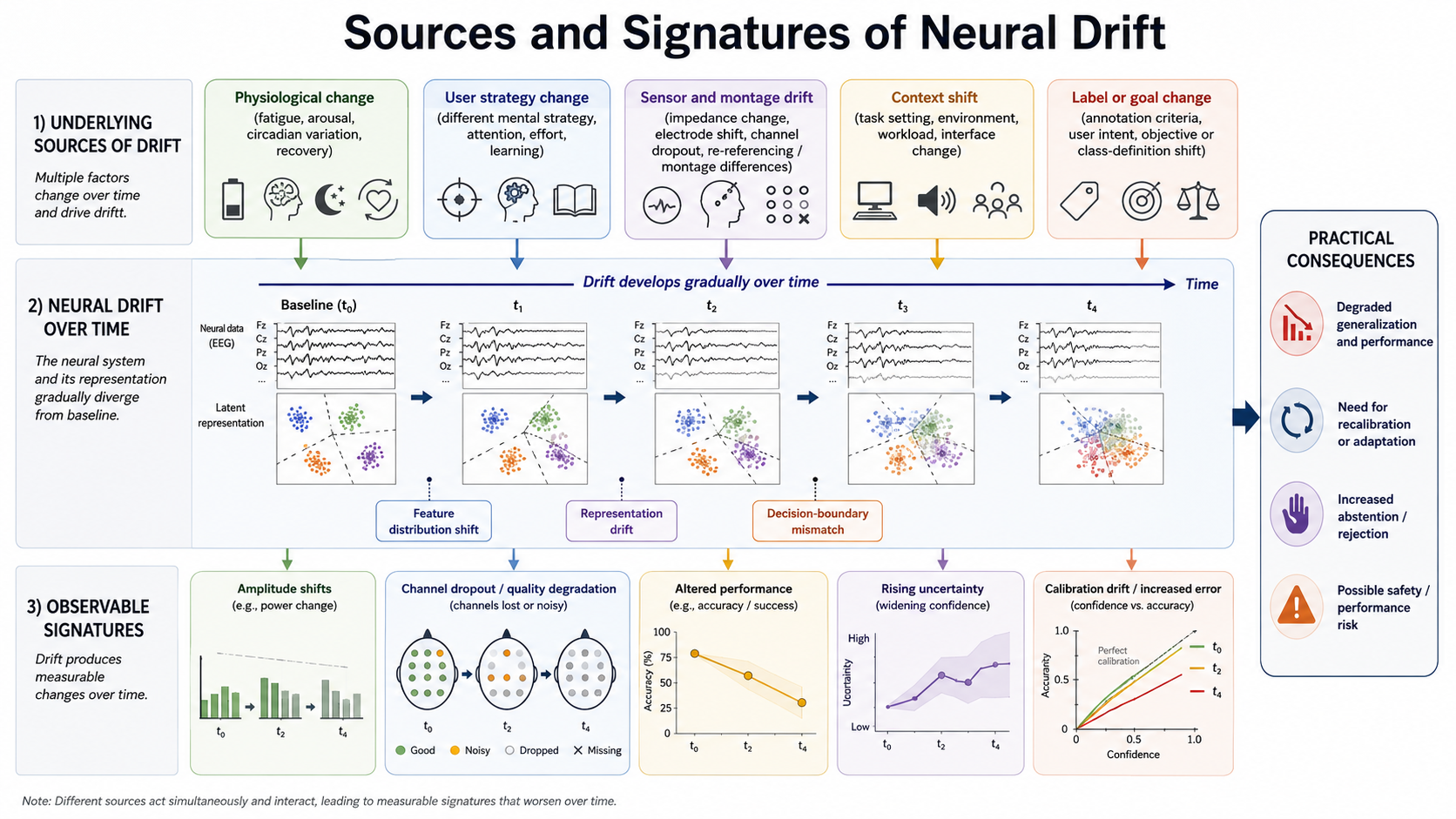
Figure 12.9: Sources and signatures of neural drift. Long-term change can arise from the user, task, sensor, context, or target; distinguishing these sources is necessary before deciding whether to recalibrate or repair the recording.
Safe Adaptation Strategies
Continual learning can use periodic recalibration, lightweight adapters, replay of representative past data, uncertainty-gated updates, or explicit user corrections. The right strategy depends on whether the system is personalized, population-level, offline, or closed loop.
Updates should be bounded. A system can require high-confidence outcomes, explicit confirmation, or a scheduled review before adding new examples to a calibration set. It can retain a stable reference model and revert when performance or signal quality crosses a predeclared threshold. These safeguards reduce the risk of self-training on an incorrect interpretation of the user's signals.
Example scenario: A wearable workload monitor compares each new session with the user's validated calibration distribution. When channel quality remains acceptable but uncertainty rises for several minutes, the system asks the user to complete a short optional calibration task. It updates only a small personalization adapter, keeps the original backbone fixed, and records the version change for later audit.
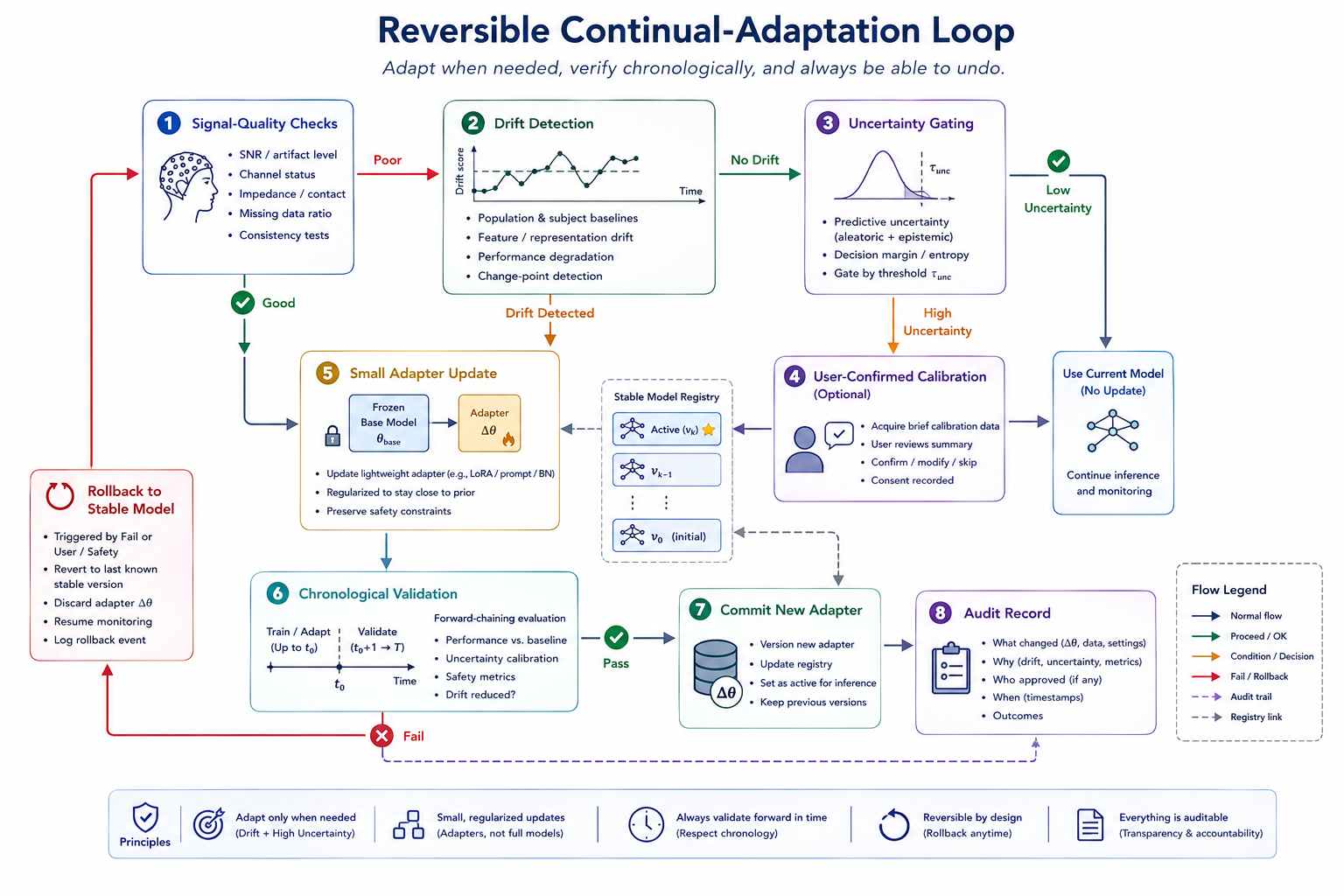
Figure 12.10: Reversible continual-adaptation loop. A safe system gates updates on signal quality and evidence, validates changes against prior behavior, records model versions, and supports rollback when adaptation harms performance or user control.
Avoid Catastrophic Forgetting
A model adapted to one user or session can lose performance on previously supported users or tasks. This is catastrophic forgetting. Common mitigations include replay buffers, regularization toward previous parameters, modular adapters, and mixture-of-expert designs. Each has a privacy and storage cost when it retains personal neural data.
Evaluation should measure both plasticity and stability: how much the model improves for new conditions and how much it preserves prior validated behavior. Reporting only the newest-session score can hide a system that improves by forgetting everyone else.
Lifelong Evaluation
Long-term evaluation requires chronological protocols. Report performance over sessions, time since calibration, adaptation events, model version, signal-quality changes, and user training history. Compare fixed, periodically recalibrated, and continually adapted systems under equal user time and feedback conditions.
Useful outcomes include time-to-recalibration, abstention frequency, recovery after sensor loss, calibration burden, stability of user agency, and performance after a model rollback. A lifelong system should fail visibly and recover safely, rather than quietly becoming overconfident. Session-scale monitoring, bounded updates, and rollback during live operation are specified as engineering requirements in Chapter 10; this section concerns longer-term lifelong change.
User Control and Data Lifecycle
Personalization data are sensitive. Users should be able to inspect whether adaptation is active, pause it, request recalibration, revert to a previous model, and remove stored calibration data where feasible. A system should distinguish transient session state from longer-term preferences and avoid turning every interaction into permanent training data.
The future challenge is not adaptation at any cost. It is adaptation that remains transparent, reversible, and beneficial as people and devices change together.
References
- Parisi, G. I., Kemker, R., Part, J. L., Kanan, C., and Wermter, S. (2019). Continual lifelong learning with neural networks: A review. Neural Networks, 113, 54-71.
- Lotte, F., Larrue, F., and Muehl, C. (2013). Flaws in current human training protocols for spontaneous brain-computer interfaces: Lessons learned from instructional design. Frontiers in Human Neuroscience, 7, 568.
- Millan, J. del R., Rupp, R., Muller-Putz, G. R., et al. (2010). Combining brain-computer interfaces and assistive technologies: State-of-the-art and challenges. Frontiers in Neuroscience, 4, 161.