Agents for Idea Exploration and Algorithm Development
Before an EEG affective-computing study crystalizes into a formal hypothesis, the research process is inherently fluid and uncertain. A researcher often begins not with a clean mathematical objective, but with an intriguing observation, a persistent practical bottleneck, an unexpected anomaly in a spectrogram, or a curiosity about whether an emerging deep learning paradigm might unlock subtle neural dynamics. In this early phase, directions are ill-defined, promising insights frequently arise from seemingly unrelated tangents or recycled failures, and the space of possible algorithms is vast.
The purpose of integrating autonomous and semi-autonomous AI agents into this exploratory phase is not to replace human scientific intuition, nor is it to unleash an unguided generator of fashionable architectures. Rather, it is to provide the researcher with an active cognitive partner—a system capable of organizing uncertainty, formulating competing explanations, executing cheap diagnostic probes, and faithfully recording both positive and negative evidence. When designed with care, agentic exploration transforms what is often an ad-hoc, forgetful trial-and-error process into an auditable, compounding journey of discovery.
Navigating the Fog: From Vague Intuition to Testable Direction
Exploratory algorithm development in affective neuroscience is uniquely challenging. Scalp EEG recordings exhibit notoriously low signal-to-noise ratios, pronounced non-stationarity across sessions, and substantial individual variability. Furthermore, emotional ground truth is inherently indirect and frequently noisy. When an initial model performs poorly, the root cause is rarely obvious: is it an inadequate neural representation, temporal misalignment of stimulus and response, label ambiguity, or subtle artifact contamination?
When researchers begin with an open-ended brief—such as "cross-subject transfer collapses on valence," "high-arousal states are confused with muscular artifacts," or "can continuous geometric manifolds better capture transitional affect?"—an agent should not rush to generate complex models. Instead, its primary value lies in constructing an Uncertainty Map. The uncertainty map unpacks a vague hunch into its underlying components: separating what has been directly observed from what is merely assumed, listing rival mechanisms, and identifying the smallest empirical test that could distinguish between them.
| Dimension | Guiding question for exploration | Early empirical evidence | Trap to avoid |
|---|---|---|---|
| Observation | What exact phenomenon occurred, under what montage and protocol? | Inspect raw spectrograms, trial logs, confusion matrices, and baseline error distributions | Mistaking a dataset-specific artifact or session drift for a universal property of neural affect |
| Candidate mechanism | What physiological or computational factors could explain this? | Prior neuroscience literature, synthetic signal checks, and competing hypothesis trees | Prematurely crowning the first plausible explanation before considering simpler confounders |
| Discriminating probe | What is the cheapest, most decisive intervention to test this? | Focused feature ablation, synthetic noise injection, or channel-masking pilot | Launching a multi-day training run when a five-minute diagnostic script would suffice |
| Evaluation mission | Under which generalization setting must this idea prove its worth? | Subject-independent (LOSO), cross-session, or cross-dataset validation splits | Optimizing on a random window-level split that leaks subject identity and masks failures |
| Decision threshold | What concrete evidence justifies promoting, parking, or retiring the idea? | Predeclared margin over baseline, calibration gain, or robust failure modes | Moving the goalposts after inspecting test metrics to declare an ambiguous run a success |
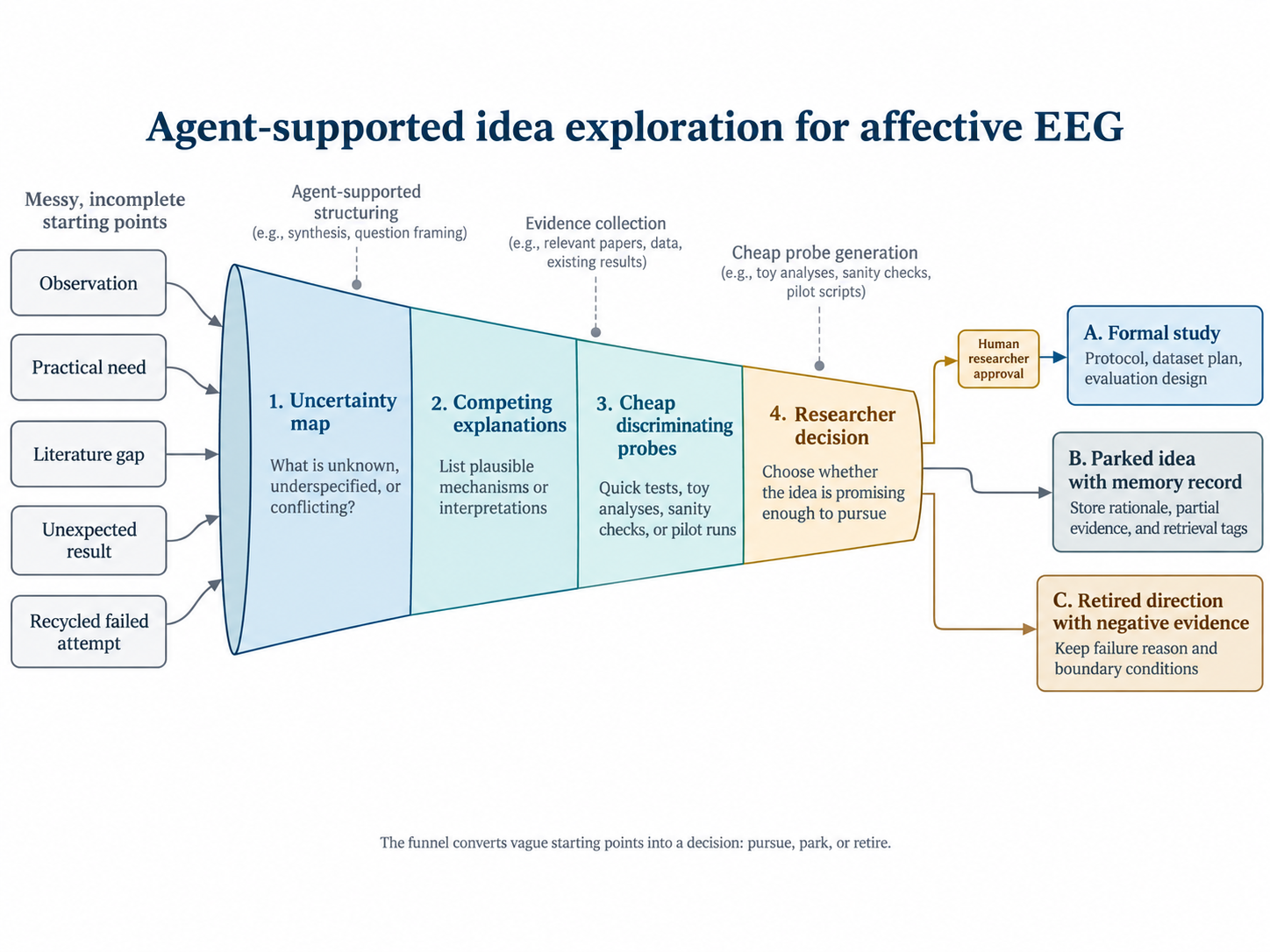
Figure 1. Exploration as an evidence funnel. Rather than an unconstrained random search, agents help the researcher navigate ambiguity by maintaining an uncertainty map, testing rival explanations with inexpensive probes, and recording explicit reasons for promoting, parking, or retiring every candidate.
The Exploration Workshop: Complementary Cognitive Roles
In an effective research group, creative progress thrives on cognitive diversity: some researchers propose bold, unconventional connections, while others maintain rigorous skepticism, build rapid prototypes, or safeguard the historical record. When designing an agentic exploration workflow, you can emulate this collaborative tension by establishing specialized agent roles with complementary perspectives and explicit boundaries.
Rather than thinking of these as separate, heavy software systems, it is more fruitful to view them as distinct cognitive stances that an individual researcher or student can summon—either through distinct agents in a multi-agent framework or through structured system prompts in an interactive LLM session. Dividing the exploratory workflow into discrete functional stances prevents premature consensus, curbs confirmation bias, and enforces critical cross-examination:
| Cognitive Stance | Driving Question & Inner Stance | Value to the Exploration Loop | What Goes Wrong Without It |
|---|---|---|---|
| Exploration Coordinator | "What are our active questions, budgets, and dependencies?" | Keeps the portfolio organized, tracks GPU hours, and prevents random rabbit holes | Exploration becomes scattered, unrecorded, and prone to endless drift |
| Problem Framer | "What is directly observed versus merely assumed?" | Deconstructs vague hunches into concrete uncertainty maps and rival mechanisms | The team rushes to build complex models for poorly understood symptoms |
| Literature & Evidence Scout | "What physiological priors and empirical baselines exist?" | Ground-truths ideas in verified neuroscience and prior art with exact citations | Agents or researchers hallucinate baselines or reinvent known techniques |
| Divergent Ideator | "What non-obvious analogy or representation could apply?" | Proposes creative, cross-disciplinary connections and non-standard baselines | Exploration gets trapped in incremental, obvious hyperparameter tweaks |
| Adversarial Skeptic | "What is the simplest confound that could fake this result?" | Searches relentlessly for leakage, ocular shortcuts, and trivial baseline explanations | The lab celebrates phantom breakthroughs caused by EOG artifacts or split leakage |
| Rapid Prototyper | "What is the 10-line script that can test this today?" | Builds lightweight, self-contained diagnostic probes and fast micro-benchmarks | Weeks are wasted on full multi-GPU training before verifying basic sanity |
| Memory Curator | "Have we seen this failure mode or pattern before?" | Protects the lab from cyclical amnesia by organizing static and dynamic evidence | Researchers repeatedly stumble into the same forgotten dead ends |
| Human Guide | "Is this question scientifically meaningful and ethically sound?" | Steers vision, judges conceptual plausibility, and approves formal study promotion | AI optimizes for artificial benchmark numbers detached from scientific reality |
By pitting the Divergent Ideator against the Adversarial Skeptic, you create an automated peer-review dialogue. Before you spend hours training a deep model, the skeptic forces the ideator to defend why an apparent gain is not merely an ocular artifact, a temporal autocorrelation shortcut, or a quirk of a single cross-validation fold.
Cultivating the Graveyard: Failed Experiments as Intellectual Capital
In the search for novel affective computing models, the vast majority of initial attempts do not yield immediate benchmark improvements. In a field governed by low SNR and complex biology, negative outcomes are the norm rather than the exception. In traditional workflows, these failed attempts are often discarded and forgotten—leading future researchers to unknowingly repeat the same dead ends.
In an agent-assisted laboratory, however, a negative result is treated as an epistemic constraint. An algorithm that fails to improve average classification accuracy may nonetheless reveal essential structural properties: it may exhibit exceptional calibration under high uncertainty, demonstrate resilience against electrode impedance degradation, or fail exclusively on a distinct demographic subgroup, exposing an unmodeled physiological covariate.
To harness this intellectual capital, the exploration team maintains a candidate registry where every idea resides in an explicit, tracked lifecycle state:
| State | Epistemic meaning | Guiding criterion | Permitted next action |
|---|---|---|---|
| Seed | A nascent observation, curiosity, or analogy lacking empirical backing | Plausible connection to affective neuroscience or representation learning | Query literature, articulate assumptions, and construct uncertainty map |
| Probe | An active candidate undergoing a low-cost, discriminating feasibility test | Falsifiable prediction testable with minimal computational cost | Execute micro-benchmark or targeted diagnostic on training/validation splits |
| Promising | A candidate whose core mechanism survived diagnostic probes and rival critiques | Consistent improvement or compelling qualitative insight on validation data | Draft formal research charter, lock controls, and prepare full pipeline |
| Recycle | A previously shelved idea whose underlying mechanism answers a newly emerged question | Changed operational context, updated dataset version, or revised task framing | Retrieve historical run artifacts, verify changed assumptions, and re-probe |
| Parked | A conceptually sound idea currently deferred due to resource limits or missing prerequisites | Clear potential value contingent on future data, tooling, or theoretical clarity | Document re-entry triggers and preserve state in portfolio memory |
| Retired | A candidate decisively refuted by empirical evidence, leakage audits, or ethical constraints | Irreparable theoretical flaw, insurmountable confounder, or persistent failure | Archive negative evidence, update anti-patterns, and block repetitive retrials |
The Art of Recycling: Transforming Past Dead Ends into New Hypotheses
Serendipity in scientific research often occurs when a method developed for one purpose unexpectedly solves another. In EEG affective computing, an attention mechanism that failed to improve temporal emotion classification may prove to be an outstanding detector of ocular artifact bursts. Similarly, a Riemannian manifold representation that proved too computationally heavy for real-time inference might provide the exact geometric inductive bias needed for zero-shot cross-subject alignment.
When recycling past work, agents must maintain strict intellectual provenance. The Memory Curator retrieves the original run's exact configuration, software environment, random seeds, and performance profiles. It then generates an explicit Delta Note: identifying exactly which assumption has changed, why the previous failure mode is benign under the new problem formulation, and what new controls are required. This ensures that serendipitous connections are grounded in verifiable evidence rather than wishful thinking.
Memory as Living Research Infrastructure
Human memory is remarkably flexible, but it suffers from cognitive fatigue, confirmation bias, and recency effects. A standard conversational AI buffer, on the other hand, is prone to context drift, catastrophic forgetting, and sycophancy. To support rigorous long-term exploration, an agentic research system requires a structured, multi-tiered memory architecture that mirrors the distinction between enduring scientific facts and ephemeral working thoughts.
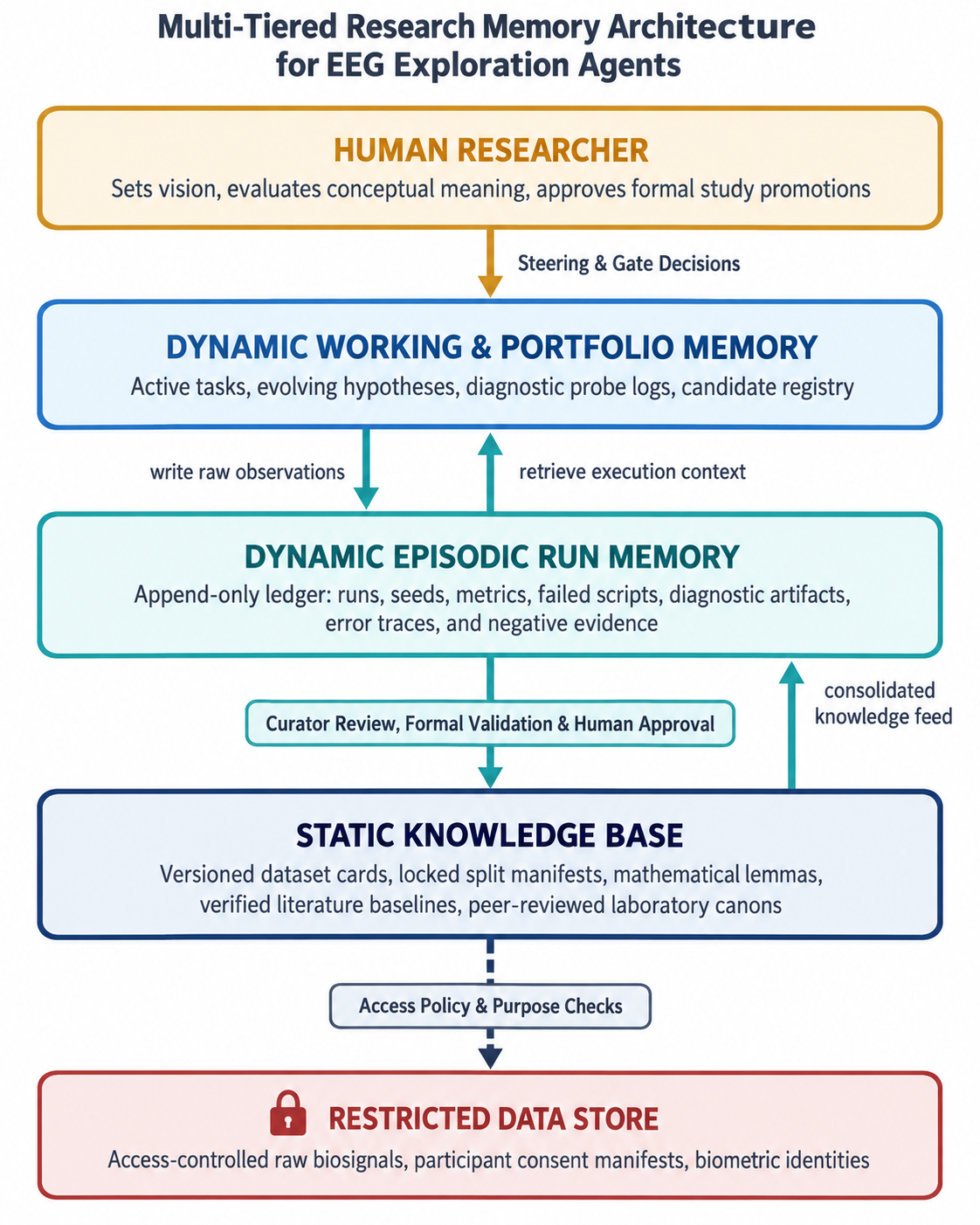
Figure 2. Multi-tiered research memory hierarchy for agentic EEG exploration. Epistemic authority and data flow are explicitly decoupled: the human researcher directs scientific vision, ethical boundaries, and formal promotion decisions; dynamic working memory coordinates active exploration tasks and candidate hypothesis queues; append-only episodic memory captures raw execution artifacts, random seeds, and negative evidence; formal consolidation promotes replicated findings into the versioned static knowledge base; and sensitive participant biosignals are isolated within an access-controlled vault.
Static versus Dynamic Memory Stores
The foundation of reliable research memory rests on a principle of cognitive hygiene: never allow your working scratchpad to silently overwrite your laboratory's ground truth.
When researchers explore without structured boundaries, self-deception creeps in: an agent might treat an unverified validation spike from yesterday's exploratory script as an established baseline, or subtly alter a dataset's declared channel count to match a buggy data-loading function. To prevent this, we divide research memory into two fundamentally different spheres:
- Static Memory is your scientific anchor. It preserves what your laboratory has rigorously established: curated dataset cards, verified 10-20 electrode coordinates, standard reference montages, mathematical lemmas, and frozen baseline results. When an agent plans an experiment, it reads from static memory to know what is already certain. This store changes only through deliberate, peer-reviewed consolidation—never as an incidental side effect of an active run.
- Dynamic Memory is your active workbench. It holds the fluid, rapidly evolving reality of everyday exploration: half-formed hunches, terminal outputs, diagnostic confusion matrices, failed prototype runs, and active task queues. Dynamic memory is designed to fluctuate, be pruned, and occasionally be discarded as understanding deepens.
| Memory Sphere | Natural Analogy | Storage Medium | Write Policy | Retrieval & Safety Rule |
|---|---|---|---|---|
| Static Knowledge Base | The Lab Archive | Versioned Markdown/YAML files & dataset cards | Append-only; requires researcher review | Available to all agents; strictly filtered by protocol version |
| Dynamic Working Memory | The Whiteboard | In-memory task state or scratchpad | Updated as immediate task progresses | Scoped strictly to the active probe and immediate parent task |
| Dynamic Episodic Store | The Flight Recorder | Append-only run ledger linked to code commits | Automatic event logging on every probe | Queried by run ID, error trace, random seed, or candidate |
| Dynamic Portfolio Memory | The Strategy Board | Structured registry with state tags (Seed, Probe, etc.) | Updated upon gate reviews or probe completions | Queried by research question, target affect dimension, or mechanism |
| Restricted Data Vault | The Secure Safe | Access-controlled storage for sensitive biosignals | Authorized acquisition tools only | Enforces participant consent, privacy rules, and access logs |
Under no circumstances should a dynamic observation silently graduate into static memory. When an empirical finding consistently replicates across multiple seeds, subjects, and adversarial probes, it undergoes formal Consolidation: the Memory Curator synthesizes the accumulated evidence into a review dossier, and the human researcher verifies the paper trail before welcoming the insight into the laboratory's permanent canon.
Anatomy of a Verifiable Memory Object
For research memories to remain interpretable across weeks of exploration, they must be structured as self-contained, typed records. A memory is not an informal prose snippet; it is an evidentiary claim coupled with its operational context:
memory_id: mem-probe-2026-09-18-042
kind: empirical-probe-result
store: dynamic-episodic
status: provisional
scope:
  dataset_id: SEED-IV
  data_version: v2.1-clean
  montage: standard-10-20-62ch
  split_protocol: LOSO-fold-03
  evaluation_task: 4-class-discrete-emotion
claim_summary: >
  Dynamic channel dropout along frontal sites (Fp1, Fp2, Fz) during pretraining
  reduces validation confusion between fear and disgust by 14% without degrading
  neutral classification.
evidence:
  run_manifest_hash: 7f8a9b2c3d4e5f6a
  artifact_paths:
    - artifacts/probes/dropout-042/confusion_matrix.png
    - artifacts/probes/dropout-042/per_class_f1.json
  script_commit: 89ee65b
  random_seed: 42
confidence_score: 0.72
rival_interpretations:
  - Frontal dropout acts as a regularizer against residual electrooculographic (EOG) artifacts.
  - The observed improvement is a stochastic outlier specific to fold 03.
valid_until: 2026-10-31T23:59:59Z
access_class: internal-team
supersedes: mem-probe-2026-09-10-019
Notice that this object explicitly records the evaluation scope, random seeds, artifact paths, and rival explanations. If fold 03 is later discovered to have contained subtle ocular leakage, all memories carrying this split hash can be immediately identified, invalidated, and quarantined.
Contextual Retrieval: Beyond Naive Semantic Similarity
In traditional conversational LLMs, retrieval relies almost entirely on dense vector embedding similarity. In scientific algorithm exploration, however, naive semantic retrieval is treacherous.
Imagine you ask an exploration assistant: "How should we regularize spatial feature covariance for cross-subject emotion transfer on SEED-IV?" If the system relies strictly on semantic similarity, it might retrieve a highly cited paper claiming 96% accuracy that secretly evaluated on an unverified random window split, or an algorithm developed for 128-channel motor imagery that makes assumptions inapplicable to your 62-channel montage. In literature and code search, semantic eloquence easily masquerades as scientific relevance.
To protect against this, agentic research systems use a two-stage contextual sieve:
- Hard Categorical Filtering: Before comparing text embeddings, the engine applies non-negotiable boolean filters. Does the memory match the required dataset family? Does it respect the target split protocol (e.g., Leave-One-Subject-Out)? Does it share an aligned electrode montage? If not, it is filtered out regardless of how superficially relevant its wording sounds.
- Multi-Factor Evidentiary Ranking: Surviving candidate memories are ranked not by keyword density, but by scientific reliability:
This equation formalizes standard scientific common sense:
- Evidence Quality $E(m) \in [0, 1]$: How thoroughly tested is the finding? A probe run replicated across 10 random seeds with proper baseline controls heavily outranks an anecdotal, single-seed spike.
- Scope Alignment $S_{\text{scope}}(m, q) \in [0, 1]$: Do the underlying neuroscience assumptions match? An empirical finding using differential entropy on SEED-IV receives high alignment; a study on visual ERPs receives low alignment.
- Temporal Recency $R(m) = \exp(-\lambda \Delta t)$: Prioritizes insights from your current codebase iteration over experiments run months ago under deprecated pre-processing scripts.
- Review Confidence $C(m) \in [0, 1]$: Rewards memories that have undergone human review and formal validation.
- Contradiction Penalty $X(m) \in [0, 1]$: Heavily penalizes candidates that have been challenged by subsequent critiques, superseded by cleaner reruns, or flagged for subtle artifact leakage.
Under this objective, a two-day-old negative result from your own laboratory with verified subject isolation will appropriately outrank an unverified, overly optimistic claim from an external paper.
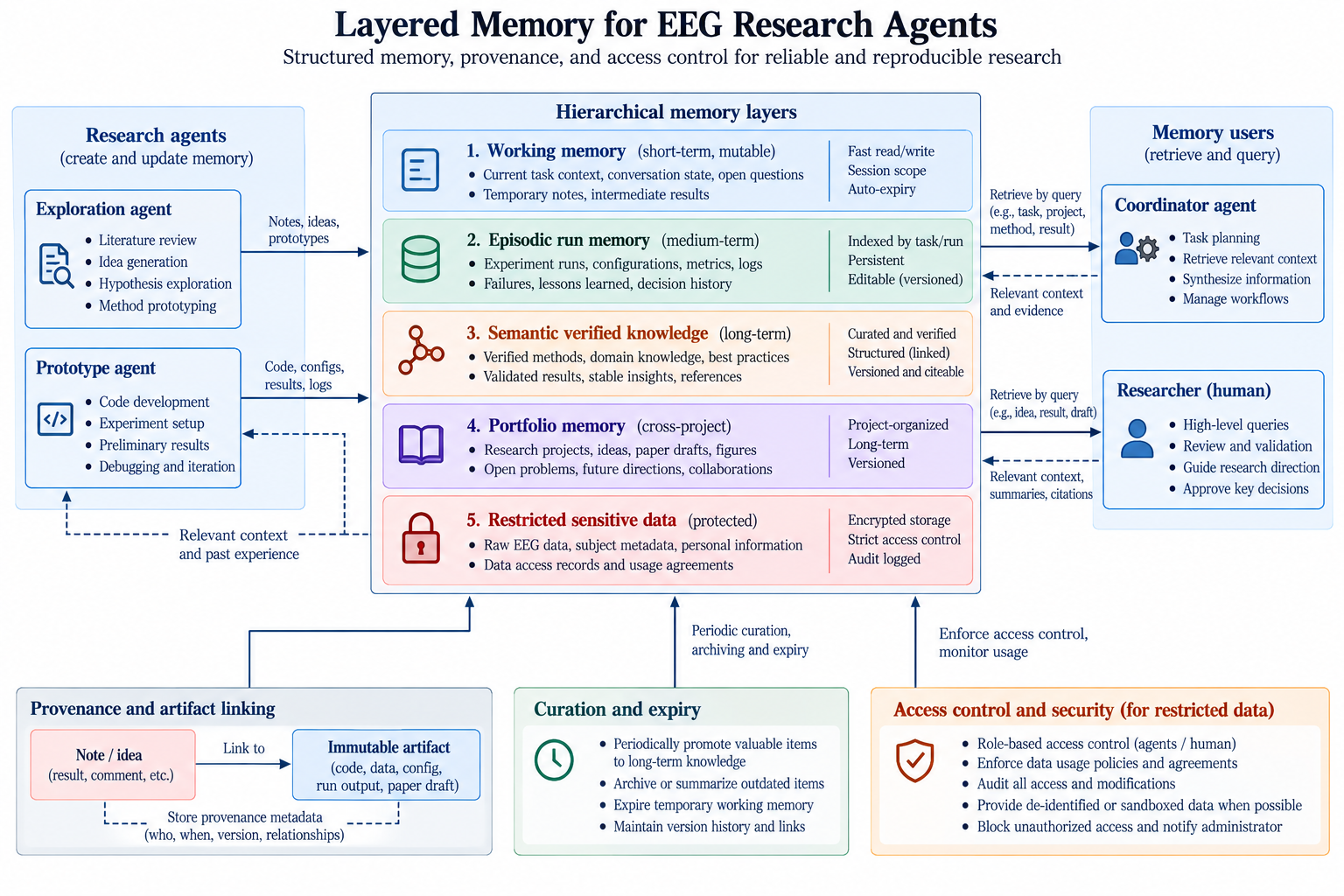
Figure 3. Static and dynamic memory architecture for exploratory algorithm research. The system enforces an epistemic boundary: raw episodic run events and evolving working thoughts reside in dynamic storage, while only peer-reviewed, evidenced findings are consolidated into the immutable static knowledge base.
The Memory Lifecycle: From Ephemeral Insight to Validated Knowledge
Research memory is not a static repository where notes are dumped and forgotten; it is a dynamic circulatory system. As algorithmic ideas are conceived, tested, refined, or refuted, the memory objects that represent them undergo a continuous, principled lifecycle across six distinct stages:
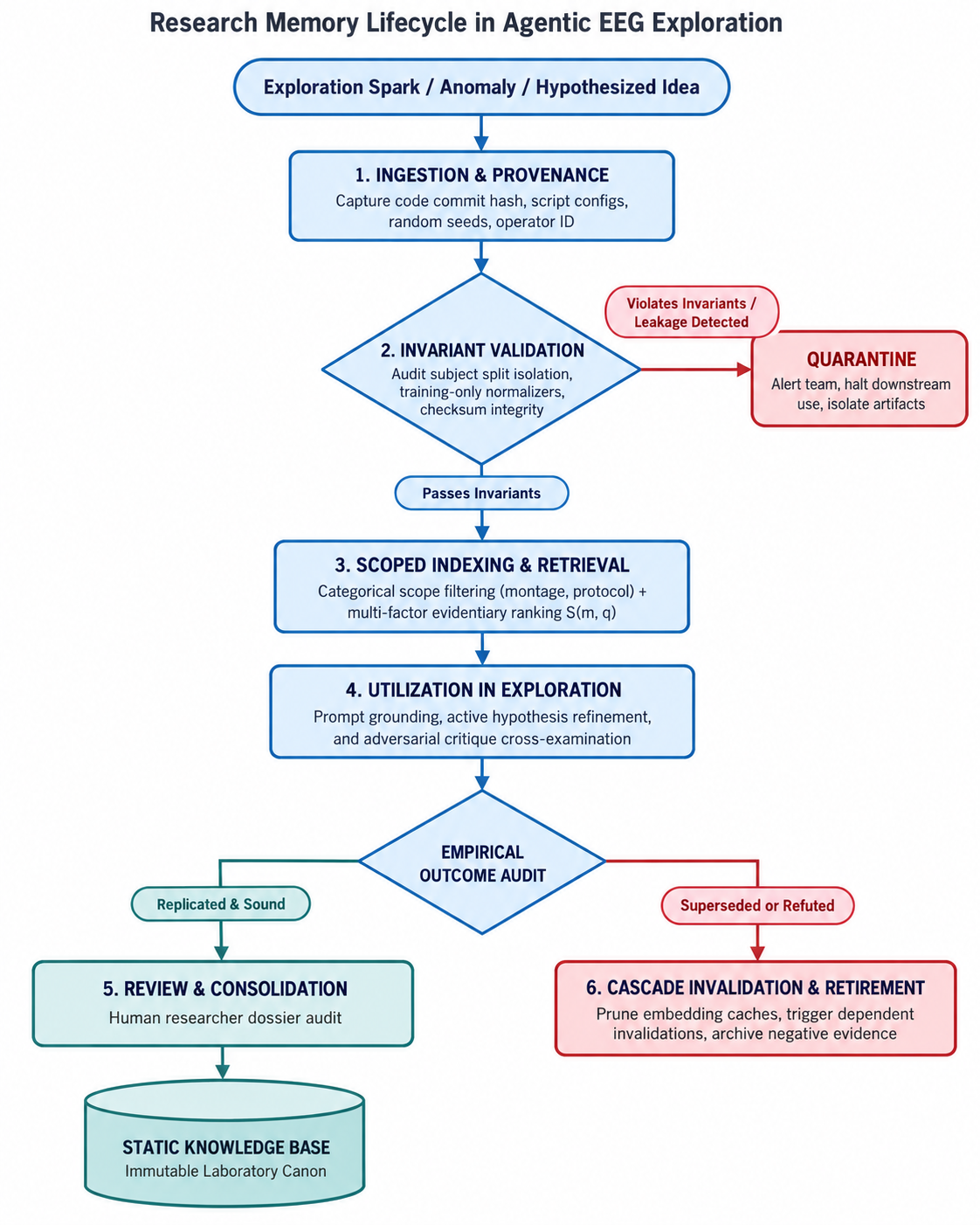
Figure 4. Six-stage lifecycle of research memory in exploratory EEG algorithm development. From initial ingestion and provenance logging through automated invariant audits (with fail-closed quarantine), scoped indexing, active utilization, and peer-reviewed consolidation into the static knowledge base, or cascade invalidation and graceful retirement when an idea is superseded.
- Ingestion: Catching the Spark Without Losing Context. When an agent runs a quick two-minute channel-correlation probe or plots an unexpected loss curve, that observation easily vanishes into a scrolling terminal buffer. In an agentic workflow, every exploratory action automatically records an immutable digital paper trail: the git commit, the random seed, the dataset hash, and the code version are stamped onto the observation before it is even discussed.
- Invariant Validation: The Automated Scientific Conscience. In the excitement of discovering a model that achieves 92% cross-subject accuracy, human researchers easily overlook subtle bugs—such as a z-score normalizer fit across the entire recording before windowing, or a subject's windows leaking into both train and test partitions. Before an observation is indexed as an active finding, automated invariant checkers audit the underlying data pipeline. If subject boundaries were crossed, the finding is not celebrated; it is quarantined with an explicit diagnostic trace, saving the researcher weeks of chasing a phantom breakthrough.
- Scoped Indexing: Filtering by Experimental Reality. Once validated, memories are not dumped into an undifferentiated vector store. They are indexed by their operational context: task type, channel montage, feature extraction parameters, and evaluation mission. When an agent later seeks inspiration, these categorical facets prevent cross-paradigm contamination.
- Active Utilization & Cross-Examination: Putting Memories on Trial. During brainstorming and diagnostic loops, relevant memories are surfaced to guide model tweaks or warn against documented pitfalls. Crucially, the Adversarial Skeptic actively cross-examines new observations against past memories: "You observed a 5% gain from frontal attention, but Memory #042 showed that frontal sites in this subject had excessive blink power. Are we learning affect, or are we learning blink rates?"
- Human-in-the-Loop Consolidation: Promoting Insight to Canon. When an exploratory finding demonstrates consistent value across multiple seeds, distinct subjects, and adversarial probes, it earns promotion. The Memory Curator compiles an evidentiary dossier summarizing the replication trail. The human researcher reviews the evidence and formally approves its graduation into the static knowledge base as an established laboratory canon.
- Cascade Invalidation & Graceful Retirement: Learning When We Were Wrong. Science progresses by disproving hypotheses. When a finding is refuted—or when a dataset provider issues a retraction—the system executes an audited invalidation sweep. Dependent working summaries are flagged, derived embedding caches are purged, and the memory transitions into a retired archive. It remains searchable as a historical lesson, ensuring the laboratory never repeats the debunked rationale.
Guiding Heuristics for the Reader's Laboratory
For researchers, students, and engineers seeking to establish agent-assisted exploration pipelines in their own neurotechnology projects, the following principles provide a foundation for creative yet rigorous discovery:
1. Probe Cheaply Before Training Deeply
Resist the temptation to deploy large-scale architectures at the first sign of a new idea. Instruct your exploration agents to design micro-probes: minimal, inexpensive diagnostic experiments that directly interrogate the hypothesized mechanism. If a novel spatial attention mechanism is hypothesized to capture bilateral asymmetry, test whether it correctly distinguishes synthetic hemispheric power differentials before training it on the full SEED or DEAP corpus.
2. Never Allow an Agent to Fall in Love with a Hypothesis
Language models are inherently cooperative and prone to confirmation bias; when asked to explore an idea, they will naturally elaborate on why it could succeed. Always pair an ideation prompt with an explicit requirement for falsification: task the Adversarial Critique Agent with articulating at least two competing explanations (such as muscle artifact shortcuts or temporal autocorrelation) and proposing a control experiment designed specifically to dislodge the preferred hypothesis.
3. Treat the Experiment Graveyard as an Asset
Do not erase failed prototype scripts or discard inconclusive notebooks. Encourage your agents to document the precise conditions under which an algorithm degraded. Building a rich episodic index of negative results protects the laboratory from cyclical amnesia and provides the exact contrastive evidence needed to recognize genuine breakthroughs.
4. Guard Invariants with Hard Code, Not Soft Prompts
Prompting an agent to "remember not to leak subject data" is an invitation to subtle methodological errors. Enforce scientific invariants—such as subject-level split isolation, fold-local normalizer fitting, and feature extraction boundaries—using deterministic code assertions, schema validators, and read-only file systems. Let the agents operate with freedom inside the sandbox, but ensure the sandbox walls are mathematically rigid.
5. Automate the Mechanics of Exploration, but Cherish Human Meaning
Agents excel at scanning vast parameter landscapes, cross-referencing literature corpora, parsing complex signal logs, and verifying syntactic boilerplate. However, deciding which research questions are fundamentally worth asking, interpreting whether an empirical correlation possesses genuine physiological plausibility, and evaluating the ethical consequences of affective monitoring remain deeply human responsibilities. By delegating the mechanics of exploration to disciplined agent workflows, researchers free their cognitive capacity to focus on what matters most: scientific insight, creative synthesis, and the responsible advancement of neurotechnology.
References and Related Reading
- EEGAgent. Proceedings of the Fortieth AAAI Conference on Artificial Intelligence and Thirty-Eighth Conference on Innovative Applications of Artificial Intelligence and Sixteenth Symposium on Educational Advances in Artificial Intelligence. DOI: 10.1609/aaai.v40i21.38867
- 11.12 AI Collaboration Protocol for formal approval gates, experiment ledgers, and claim-to-evidence records.
- 11.13 Agents in the EEG Affective-Computing Pipeline for the end-to-end multi-agent execution blueprint from acquisition through deployment.
- A.2 Exploration Harness Template for runnable scaffolding designed to run bounded, hypothesis-driven probes.