Affect in Embodied Intelligence
Embodied intelligence concerns systems that perceive, act, and learn through a body in the physical or social world. For robots, assistive devices, virtual agents, and mixed-reality systems, affect is not merely a label to recognize. It can influence attention, action selection, learning priorities, social coordination, and the way a system communicates its own state. EEG-based affective computing can contribute a human-centered signal to this loop, but only if affect is represented as uncertain, contextual, and actionable rather than as a fixed emotion class.
This section examines the roles affect can play in embodied systems and the research questions that arise when neural affect estimates influence physical or social action.
Four Roles for Affect
Affect can enter an embodied system in at least four distinct ways.
| Role | Question | Example |
|---|---|---|
| Human-state input | How is the person currently coping with the interaction? | An EEG workload estimate causes a robot to slow its explanation |
| Action-selection factor | Which available action best supports the user's current state and goal? | A rehabilitation device chooses lower-intensity feedback after signs of frustration |
| Learning signal | Which interaction outcomes should the system prefer over time? | Engagement and explicit ratings contribute to a reward for adaptive tutoring |
| Social communication channel | How should the system express or regulate its behavior for a person? | A companion robot changes timing, voice, or distance after confirmed discomfort |
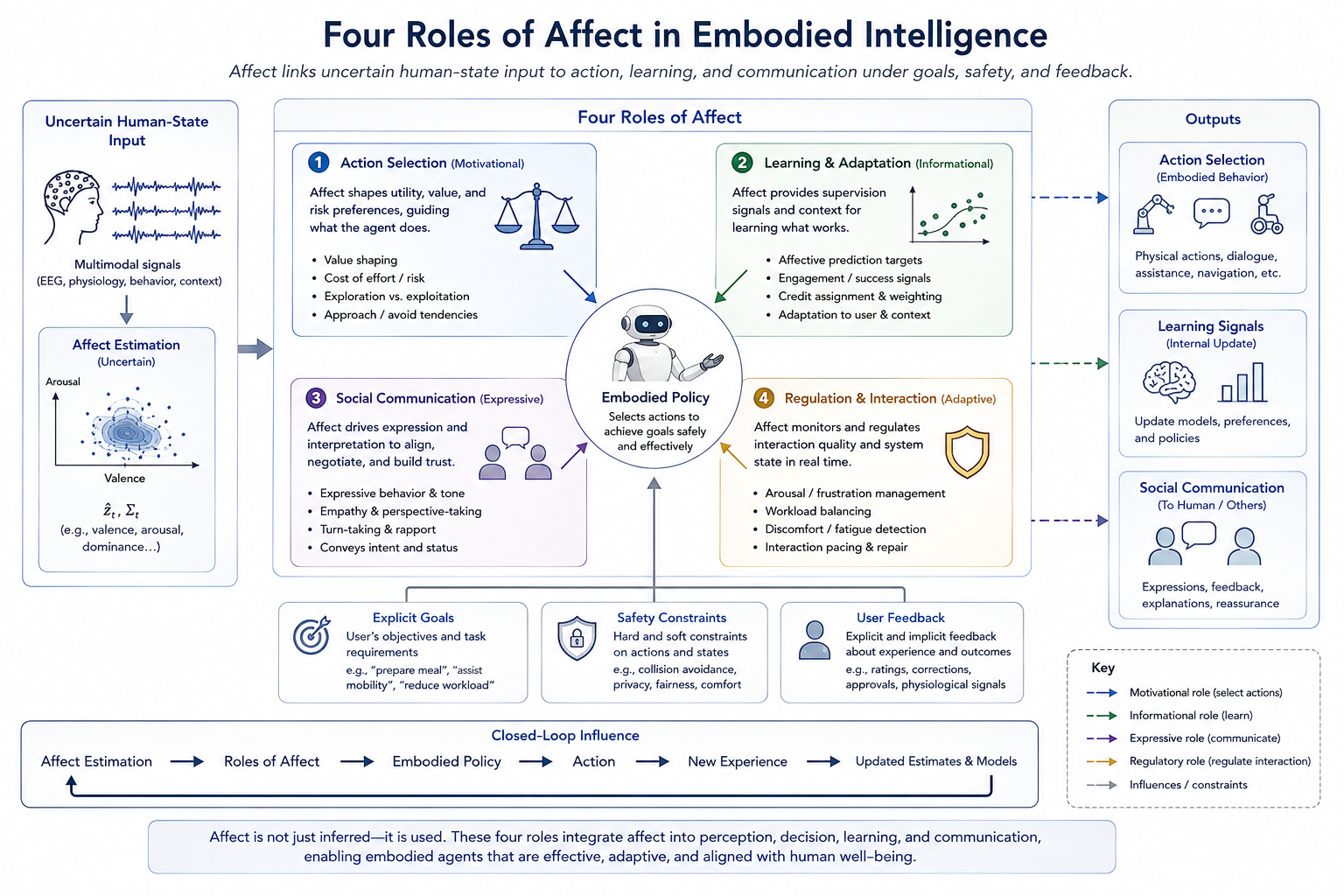
Figure 12.7: Roles of affect in embodied intelligence. Affective evidence can inform perception, action selection, learning, and social communication, but each role requires a separate policy and should not be treated as an automatic justification for intervention.
These roles should not be collapsed. A classifier may estimate a state, but a separate policy must decide whether an action is appropriate. The most accurate affect estimate does not automatically justify intervention.
Affect as Input: Contextual and Uncertain Perception
A neural affect estimate should be treated as one observation among many, alongside speech, gaze, posture, task performance, environmental conditions, and explicit user reports. The system should retain uncertainty and alternative explanations. Elevated arousal may reflect excitement, difficulty, motion artifact, environmental noise, or a sensor problem.
A useful internal representation is a belief over human state rather than a single label:
where is a latent state, is neural history, is other observed context, and is interaction history. A policy can then act on the belief and its uncertainty, not on an overconfident emotion prediction.
Example scenario: In a collaborative assembly task, a wearable EEG estimate suggests rising workload, but the system also sees that the user is moving quickly and succeeding. Rather than interrupting automatically, a robot offers optional guidance and uses the user's response to refine its interpretation.
Affect as a Factor in Action Selection
Embodied agents need to balance task efficiency, safety, learning, autonomy, and social comfort. Affect can be one factor in this decision, alongside explicit goals and environmental constraints. For a policy , an action can be chosen from a state containing task and affective information:
where describes the environment, represents uncertain human state, and represents consent and user preferences.
This formulation highlights a constraint: affect should not become a hidden objective that overrides the person. If a system detects likely stress, it may offer a break, reduce notification intensity, or ask a question. It should not silently alter an important goal, disclose a private inference, or manipulate the user toward a system-defined emotional target.
Affect as a Learning Signal
Affective feedback can help an embodied system learn which interaction policies are supportive, but it is a weak and delayed reward signal. Engagement, frustration, and arousal may be informative, yet they do not always align with learning, safety, or well-being. A difficult rehabilitation exercise can temporarily increase frustration while remaining valuable; a highly engaging interface can be distracting or manipulative.
Future systems should combine affective evidence with explicit outcomes, task performance, user feedback, and safety constraints. Reward design should penalize coercive, attention-capturing, or dependency-forming behavior. Offline reinforcement learning and simulation can help explore policies before real-world deployment, but any learned policy still requires human-centered evaluation.
Embodiment Changes the Data Problem
In passive datasets, EEG is often collected while participants view fixed clips or complete standardized trials. Embodied interaction generates a different distribution: motion artifacts, changing gaze, speaking, walking, social feedback, and nonstationary goals. The robot or interface also changes the user's state, making observations and actions causally entangled.
Future datasets should therefore record the full interaction loop: EEG and signal-quality metadata, environment state, agent actions, user actions, feedback timing, task outcomes, explicit reports, and adaptation events. Without this provenance, it is difficult to determine whether a change in affect was caused by the task, the agent, the sensor, or the user's evolving strategy.
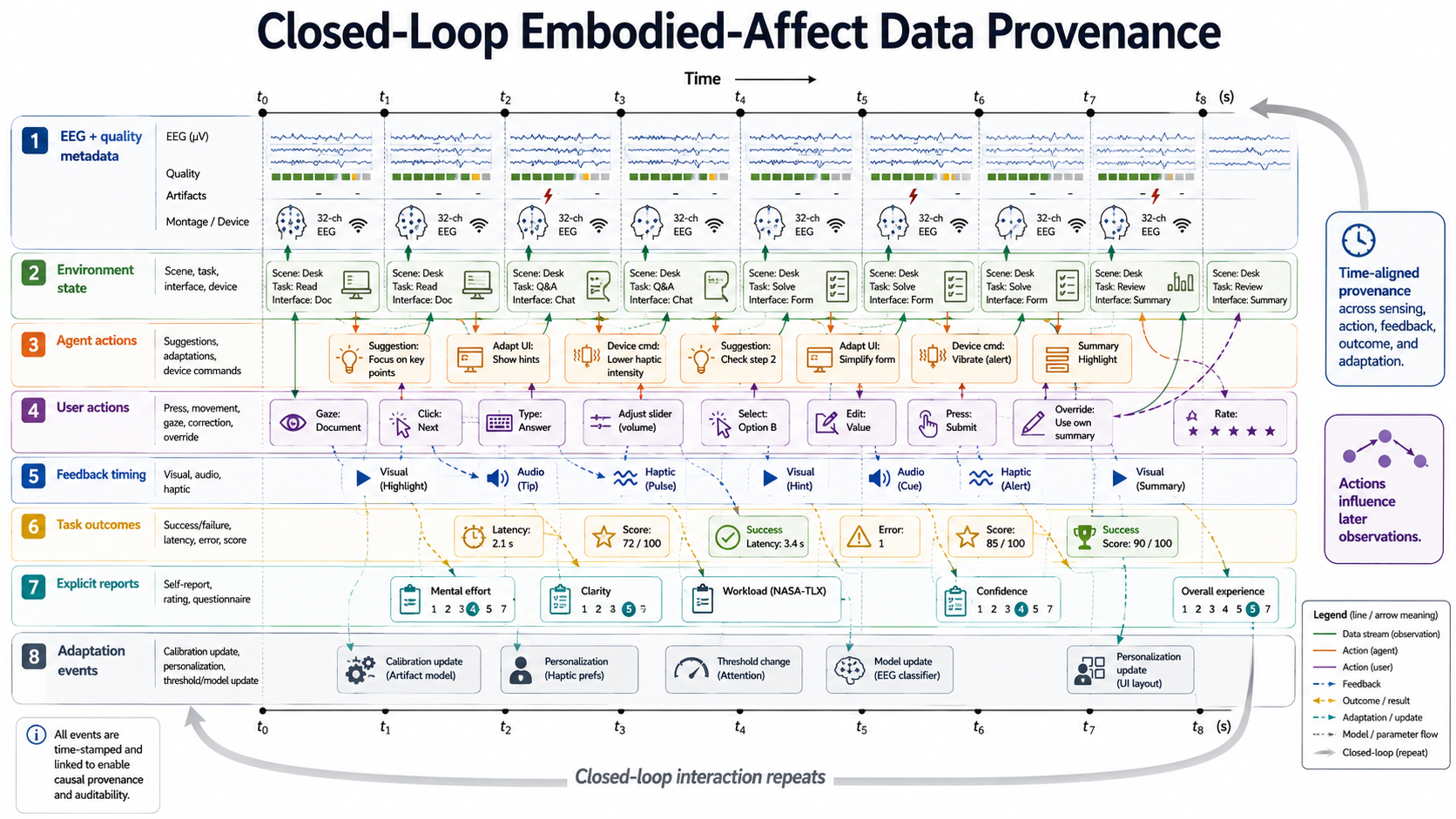
Figure 12.8: Closed-loop embodied-affect data provenance. Embodied interaction couples observations and actions, so future datasets must preserve time alignment and provenance across sensing, behavior, agent feedback, outcomes, and adaptation.
Embodied Evaluation
Affect-aware embodied intelligence should be evaluated on more than recognition accuracy. Useful outcomes include:
- task success, safety, and recovery from error;
- user control, agency, consent, and ability to override interventions;
- whether responses are calibrated to uncertainty and context;
- learning and well-being over repeated interactions;
- robustness to movement, sensor loss, and changing environments;
- fairness across users, cultures, communication styles, and accessibility needs;
- and whether an affect-aware policy improves outcomes over a context-only baseline.
Ablations are essential. Compare systems that use explicit feedback only, context only, affect estimates only, and a transparent multimodal policy. This prevents an agent's general competence from being misattributed to an EEG affect signal that has not added measurable value.
Social and Ethical Boundaries
Embodied affective systems are close to users and may influence their behavior continuously. They should be designed to support user-defined goals rather than to maximize engagement, compliance, or emotional dependence. Important protections include informed consent, visible sensing and inference states, data minimization, local processing where possible, user-accessible controls, and meaningful refusal or shutdown mechanisms.
The long-term opportunity is not a robot that claims to know how a person feels. It is an adaptive partner that uses uncertain affective evidence carefully, checks its assumptions, and helps the person remain in control of a shared task.
References
- Damasio, A. R. (1994). Descartes' Error: Emotion, Reason, and the Human Brain. Putnam.
- Breazeal, C. (2003). Emotion and sociable humanoid robots. International Journal of Human-Computer Studies, 59(1-2), 119-155.
- Picard, R. W. (1997). Affective Computing. MIT Press.
- Admoni, H., and Scassellati, B. (2017). Social eye gaze in human-robot interaction: A review. Journal of Human-Robot Interaction, 6(1), 25-63.
- Yuste, R., Goering, S., Arcas, B. A. y., et al. (2017). Four ethical priorities for neurotechnologies and AI. Nature, 551, 159-163.