LLM-Inspired Techniques for EEG
Large language models provide useful engineering ideas for EEG, but their techniques cannot be transferred by analogy alone. EEG is continuous, noisy, device-dependent, and only indirectly related to mental content. Each adaptation must preserve signal semantics, expose uncertainty, and be evaluated under the intended subject, session, device, and task shifts.
Signal Tokenization and Representation Interfaces
LLMs operate on sequences of tokens with a relatively stable vocabulary. EEG needs a declared signal interface instead. A model may represent short time-channel patches, time-frequency patches, electrode sets with spatial coordinates, or learned segments. The interface should retain montage, reference, sampling rate, missing-channel masks, artifact flags, and quality estimates rather than hiding them inside an opaque token sequence.
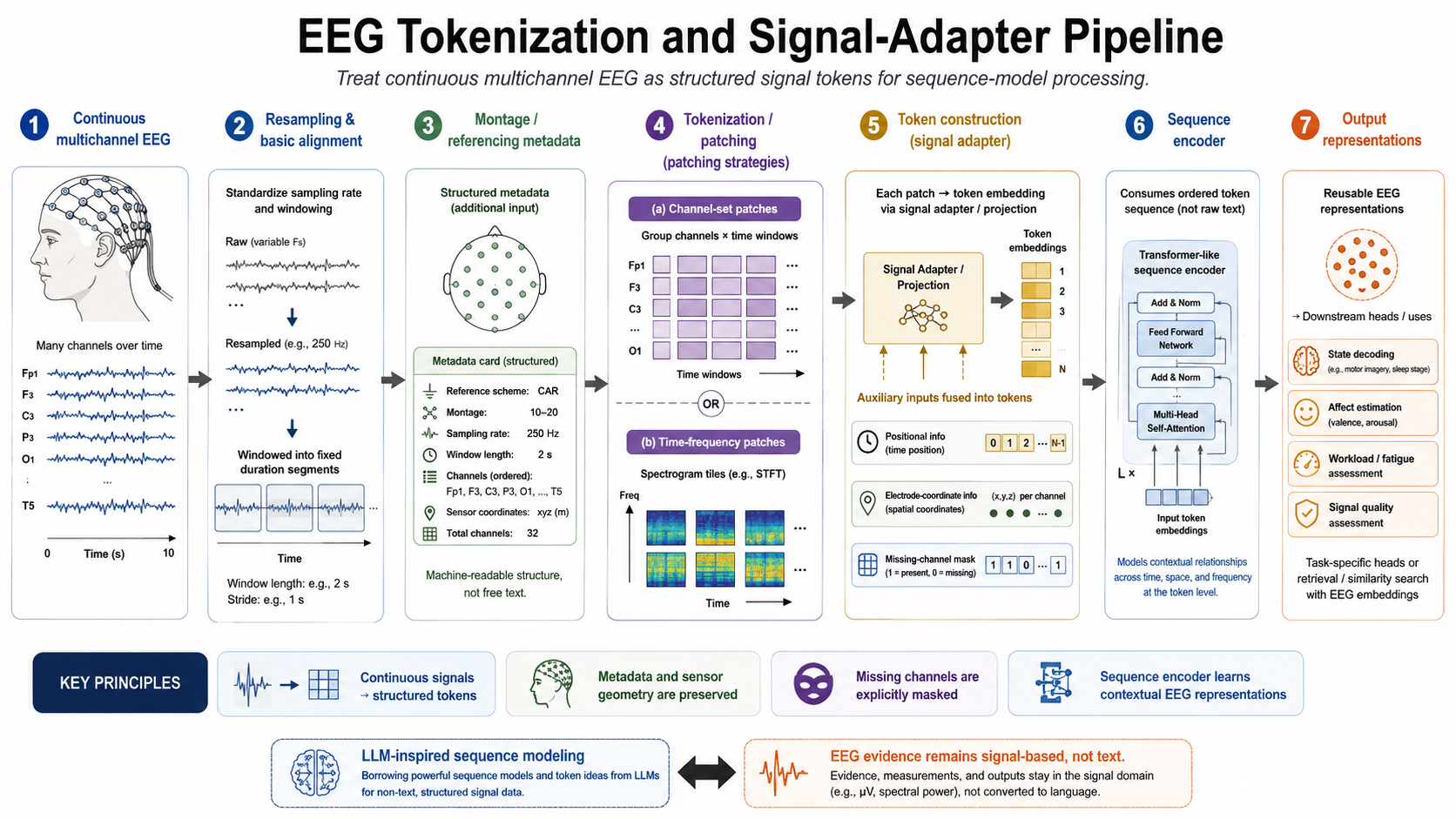
Figure 12.2: EEG tokenization and signal-adapter pipeline. EEG tokenization is a declared measurement interface that preserves temporal, spatial, device, and quality information rather than assuming a universal neural vocabulary.
Pretraining Objectives Adapted from LLMs
Self-supervised pretraining can borrow the principle of learning from broad unlabeled data while changing the objectives to fit neural signals. Useful objectives include masked time or channel reconstruction, next-segment or temporal-order prediction, cross-channel prediction, contrastive agreement between label-preserving views, and multimodal alignment with events, behavior, or peripheral physiology.
The objective should not reward reconstruction of nuisance structure alone. For example, a model that predicts electrode noise or participant identity may achieve a low pretraining loss without learning transferable affective information. Masking, augmentation, and negative-pair design should therefore be tested against downstream transfer and shortcut controls.
Instruction-Like Conditioning Without Mind Reading
Instruction tuning can inspire task and context conditioning, but an instruction cannot reveal a person's internal state. In EEG, conditioning may specify the task, recording regime, target output, calibration state, or allowed action. A system might receive metadata such as estimate workload for this task or abstain when signal quality is inadequate, but these instructions should constrain the computation rather than manufacture semantic certainty.
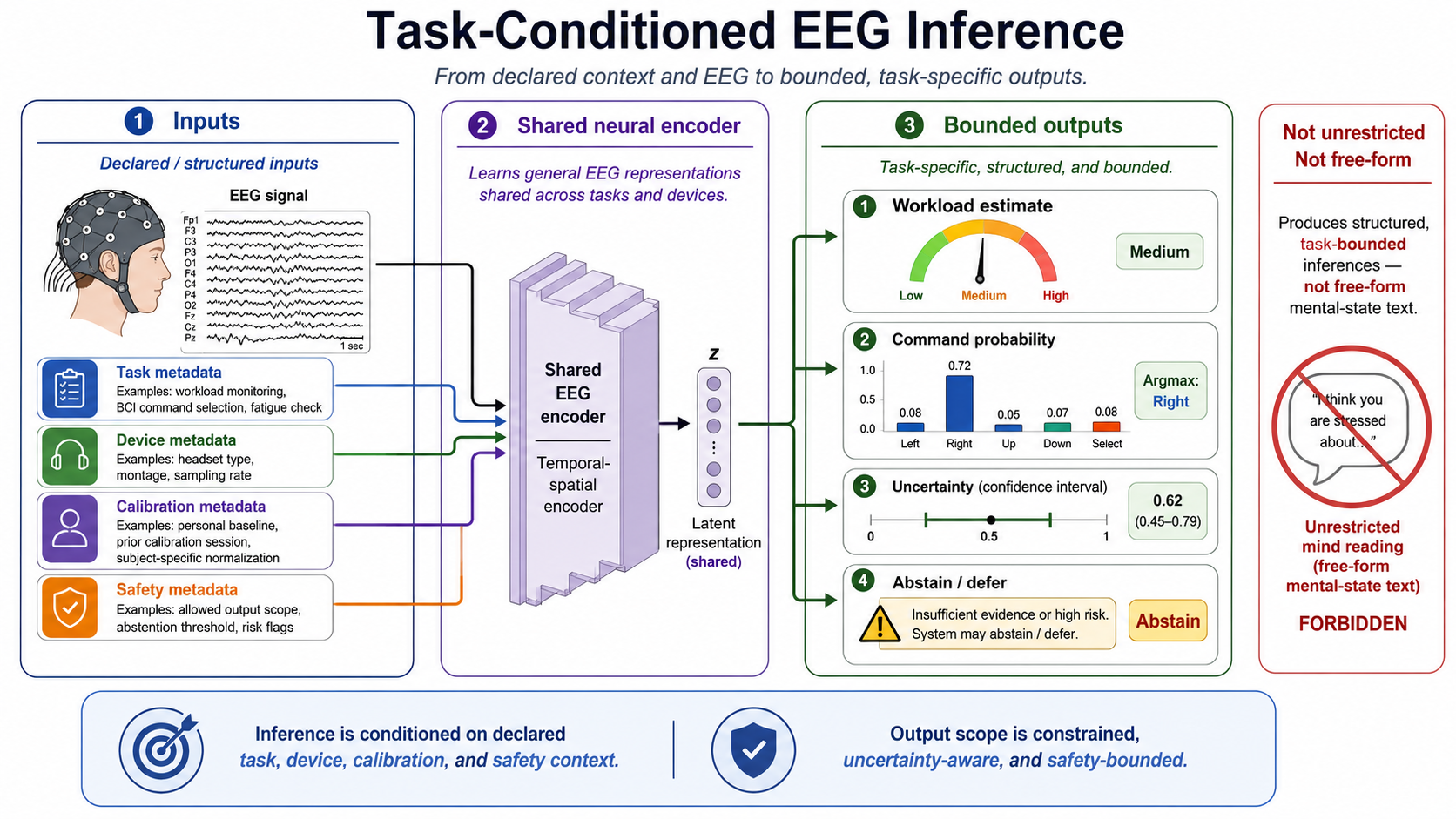
Figure 12.3: Task-conditioned EEG inference. Task and context conditioning can specialize a shared encoder for bounded objectives while keeping uncertainty, abstention, calibration, and safety constraints visible.
Retrieval, Memory, and Tool Use
Retrieval-augmented applications suggest ways to use validated context without forcing all knowledge into model parameters. An EEG system could retrieve consented calibration examples, device configuration, task history, confirmed user preferences, or prior model versions. Neural histories and derived embeddings are sensitive biometric data, so retrieval requires purpose limitation, access control, retention rules, and behavior under revoked consent.
Tools can turn uncertain estimates into bounded assistance: a quality tool can request electrode adjustment, a calibration tool can schedule a short confirmed trial, and an interface tool can offer a user-approved option. The system should distinguish reporting an estimate, proposing an action, requesting confirmation, and executing a permitted action.
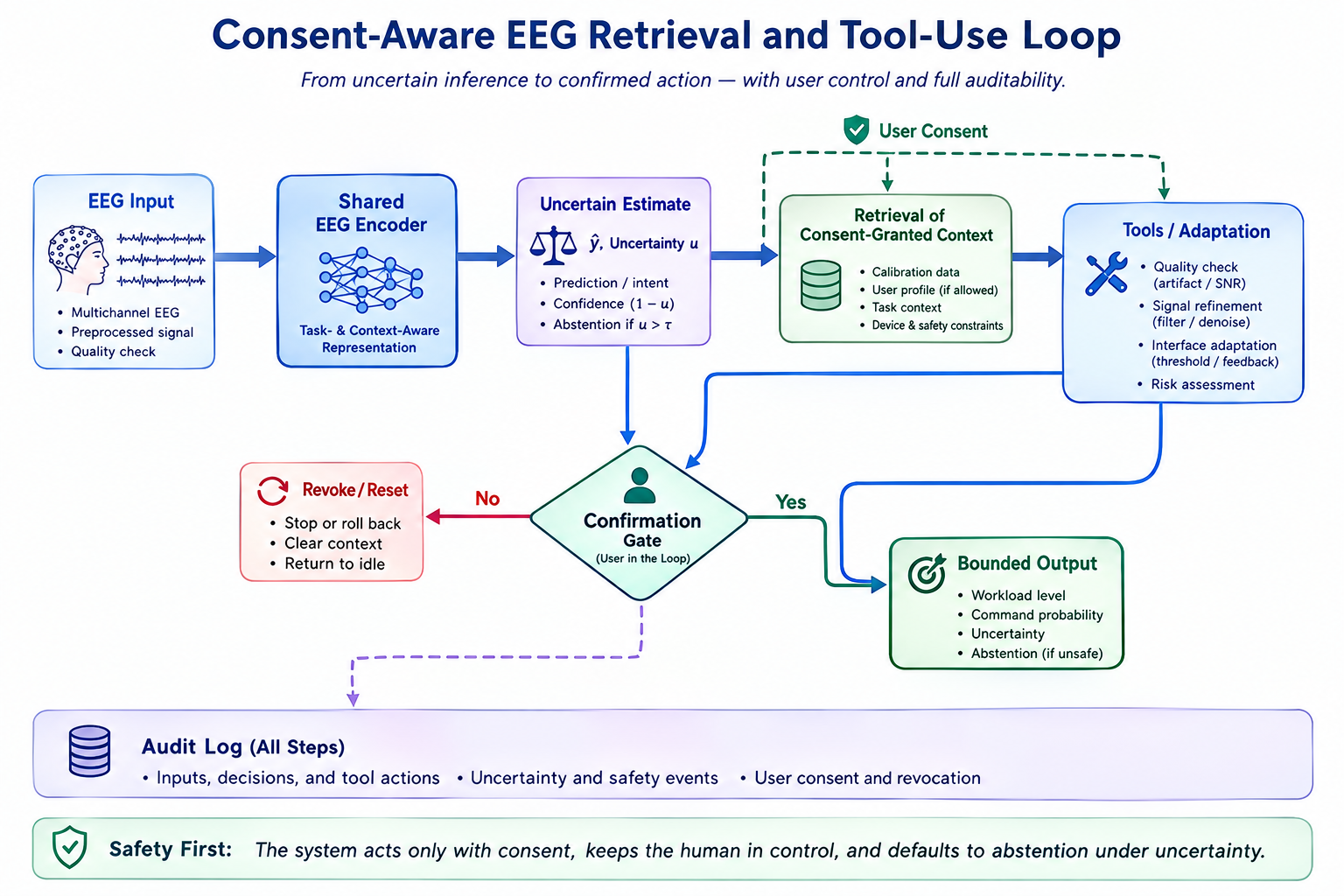
Figure 12.4: Consent-aware EEG retrieval and tool use. Retrieved neural context and external actions can improve usefulness only when access, consent, confirmation, provenance, and rollback are explicit.
Alignment and Multimodal Grounding
Neural signals become more useful when aligned with the situation in which they occur. Future systems may pair EEG with task instructions, stimulus descriptions, eye tracking, peripheral physiology, speech, video, interaction logs, and self-report. This can help distinguish similar EEG patterns arising from different contexts, but it does not justify treating every aligned embedding as a semantic translation.
A multimodal model should preserve the distinction between observed context and inferred mental state. It may know that a learner received difficult feedback and estimate elevated arousal with uncertainty; it should not conclude that the learner is angry without an appropriate target, evidence, and consent.
Evaluation of LLM-Inspired EEG Systems
Evaluation should test more than in-distribution prediction. Report transfer across subjects, sessions, devices, montages, tasks, and datasets; calibration and abstention under poor signal quality; sample efficiency during personal calibration; privacy leakage and identity memorization; and usefulness compared with no-EEG, context-only, EEG-only, and user-controlled baselines.
A model that produces fluent explanations or strong pretraining scores has not demonstrated reliable neural understanding. The relevant evidence is whether the adapted technique reduces user burden, improves a bounded task, remains honest about uncertainty, and preserves user control.
Summary
LLM-inspired techniques can provide reusable design patterns for EEG: structured signal interfaces, scalable self-supervision, task conditioning, consent-aware retrieval, tool use, and multimodal grounding. They must be adapted to the measurement properties and ethical boundaries of EEG rather than copied as if neural recordings were language.
References
- Bommasani, R., Hudson, D. A., Adeli, E., et al. (2021). On the opportunities and risks of foundation models. arXiv:2108.07258.
- Kostas, D., Aroca-Ouellette, S., and Rudzicz, F. (2021). BENDR: Using transformers and a contrastive self-supervised learning task to learn from massive amounts of EEG data. Frontiers in Human Neuroscience, 15, 653659.
- Lewis, P., Perez, E., Piktus, A., et al. (2020). Retrieval-augmented generation for knowledge-intensive NLP tasks. Advances in Neural Information Processing Systems.
- Ouyang, L., Wu, J., Jiang, X., et al. (2022). Training language models to follow instructions with human feedback. arXiv:2203.02155.